Insight
Why Half of PE CFOs Fail Within 18 Months
–
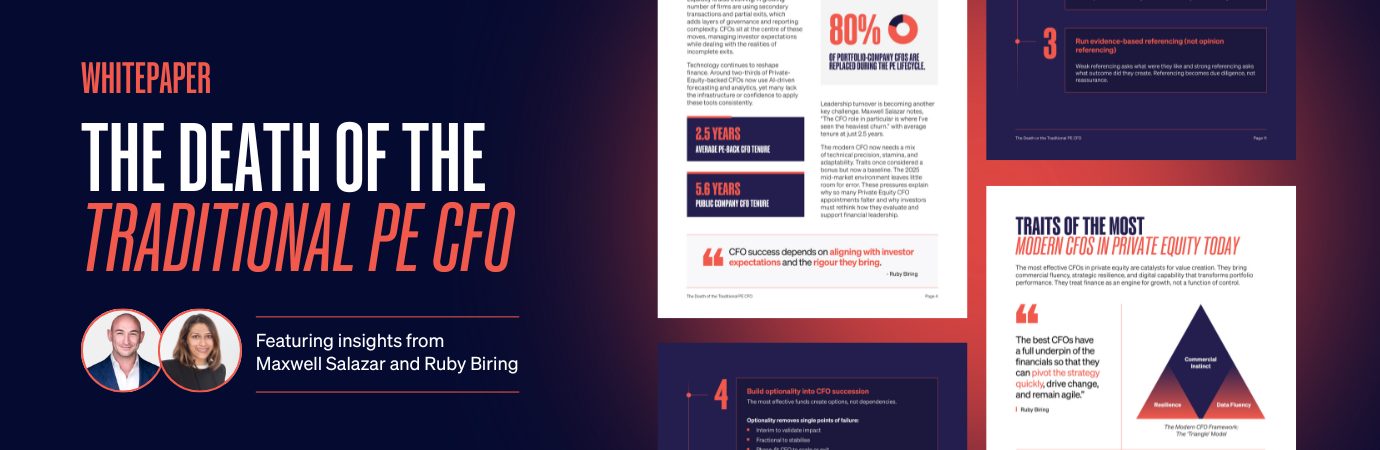
Nearly 50% of CFOs appointed into PE-backed businesses exit within their first 18 months.
It’s a statistic that feels uncomfortable, yet familiar to most investors and finance leaders working in the space. These departures rarely come as a shock after the fact. In most cases, the CFO looked strong on paper, had the right pedigree, and had succeeded in similar roles before.
This article draws on findings from STOIX’s The Death of the Traditional PE CFO whitepaper, which examines why these appointments break down so quickly. The issue sits elsewhere. What tends to fail is the fit between the CFO and the situation they are asked to operate in.
When those elements are out of sync, pressure builds quickly. Once you start to recognise the patterns behind these outcomes, the failure becomes far less surprising and far more predictable.
The real reason PE CFOs fail: Context beats capability
Those patterns point to a consistent truth. PE CFO failures are often about whether they’re suited to the environment they’ve been dropped into.
Private Equity settings are compressed and unforgiving by design. The pace is relentless, and the margin for error narrows almost immediately after a deal closes.
The data reflects that pressure. Average tenure for PE-backed CFOs now sits at around 2.5 years, compared with 5.6 years in public companies, a gap that continues to widen as hold periods stretch and operating conditions tighten.
“The CFO role in particular is where I’ve seen the heaviest churn.”
– Mark Salazar, former SVP of Executive Assessment at AlixPartners
Despite this, CFOs are still commonly hired for what they have done before rather than what the business needs next. Investors often underestimate how dramatically the role shifts once value creation, liquidity management, and pace become central.
In this environment, the CFO is no longer a reporting function. They are the value inflection point.
When the context is wrong, even excellent CFOs struggle.
The four failure archetypes
What’s striking is how often those struggles follow the same paths. Across the PE lifecycle, CFO turnover is the norm rather than the exception, with 80% of portfolio-company CFOs replaced at some point during ownership.
That level of churn has made patterns hard to ignore. In STOIX’s research, and reinforced by interviews with senior specialists, four failure archetypes appear again and again. These are not personality flaws or capability gaps, but predictable mismatches between role, context, and expectation.
Archetype 1: Archetype mismatch
This is the most common breakdown.
It occurs when a CFO is hired for the wrong phase of the investment, even though their background appears strong. The whitepaper highlights a recurring scenario: placing a steady-state controller into a growth or turnaround environment, where speed and commercial judgment matter more than precision.
The same issue appears later in the lifecycle. As Maxwell Salazar, former SVP of Executive Assessment at AlixPartners, explains, the CFO who builds financial discipline is rarely the one who can lead an exit narrative. These roles demand different instincts, even if the title stays the same.
What breaks down first:
- Decision-making slows
- Teams lose momentum
- Investor confidence erodes early
- Phase-fit matters more than familiarity.
Archetype 2: CFO / CEO misalignment
In this scenario, the CFO and CEO are both capable, but they are not aligned on how the business should move. The whitepaper defines this as different interpretations of strategy or pace, which gradually erodes trust and weakens board cohesion.
From an assessment perspective, this misalignment often shows up under pressure. Salazar notes the importance of understanding whether a CFO becomes defensive in board discussions or defaults to tactical detail instead of strategic judgment. These behaviours shape how decisions are made long before performance issues are visible.
What looks like a relationship problem is usually structural. Chemistry between CFO and CEO determines how the organisation functions day to day.
Archetype 3: Speed over substance
This pattern is driven by urgency rather than intent. Deal timelines compress, a CFO exits unexpectedly, or pressure builds to stabilise reporting. The whitepaper is explicit here: quick hires made under deal pressure reduce diligence and lead to poor fit.
In these moments, hiring teams lean heavily on CVs and references, while judgment, adaptability, and decision-making under uncertainty go largely untested. The result is a hire that feels safe but fails to hold up once the environment asserts itself.
Speed matters in Private Equity.
Speed without evidence is where risk compounds.
Archetype 4: Narrow commercial view
The final archetype is quieter, but no less damaging. The whitepaper describes CFOs with strong technical skills but limited strategic awareness, who struggle as priorities shift.
Reporting remains solid, controls are in place, yet the CFO defaults to monitoring rather than shaping outcomes. Over time, they become a bottleneck to commercial decisions, reducing optionality for investors.
This is why assessment matters. As Salazar’s interviews underline, investors need to know whether a CFO can operate strategically when information is incomplete, not just when the numbers are clear.

Why these failures keep repeating
The patterns persist because the hiring system hasn’t kept pace with how the CFO role has changed. Across PE-backed businesses, the same issues show up again and again:
- Hiring processes still favour familiarity, pedigree, and prior exits over relevance to the current situation
- Firms default to “done it before” logic, assuming past success guarantees future fit
- Assessment focuses on experience rather than judgment
- Interviews rarely test how CFOs make decisions under pressure
Until these habits change, the same outcomes will continue to repeat.
What successful PE firms do differently
Firms that consistently retain CFOs approach the role as a value lever, not a replacement hire. Instead of defining the role by background, they define it by what the CFO must deliver over the next 12 to 24 months. The value-creation thesis becomes the starting point, not the CV.
Assessment then shifts from narrative to evidence. Progressive firms replace career walk-through interviews with scenario-based evaluation, placing CFOs into real portfolio challenges to observe judgment under pressure. This exposes how decisions are made when information is incomplete, not just how experience is described.
Referencing follows the same logic. Outcomes matter more than opinions. Leading funds treat referencing as diligence, asking what value was created, under what conditions, and whether it could be repeated.
To reduce risk further, many firms build optionality into succession, using interim, fractional, and phase-fit CFO models rather than forcing a single permanent solution too early.
Failure is predictable, and preventable
Most PE CFO failures follow the same patterns, and they are rarely down to chance. These outcomes are the result of repeatable decisions made during hiring, assessment, and succession planning.
When context, phase, and expectations are clearly defined, success rates change materially.
The real question is no longer why CFOs fail, but why firms continue to hire in ways that make failure likely.
For a deeper look at the data, interviews, and frameworks behind these patterns, download the full Death of the Traditional PE CFO whitepaper.